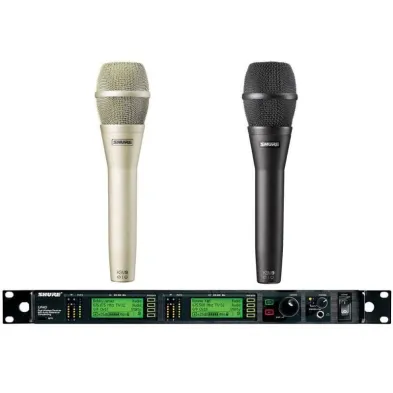
Microphone Wireless UR24D/KSM9 Shure

0 Reviews

Rp2.350.000 /Day

Store
0 out of 5

Shure UR24D/KSM9 wireless microphone

Shure UR4d Receiver


RF Carrier Frequency Range G1/470 – 530 MHz
Signal-to-Noise Ratio Ultimate Quieting (ref. 45 kHz deviation) <100 dB, A-weighted
Overall Frequency Response 40Hz to 18kHz +/- 1dB
# Of Channels 2400 Selectable Frequencies Across 60 MHz Bandwidth
Type of Receiver UR4S+ (single) Receiver – Diversity
Type of Outputs XLR 3-pin: Mic/Line Switchable, Balanced Low-Z with Ground Lift Switch 1/4? Phone: 200 ohms USB: Computer Interface RJ-45: Ethernet Network Interface
Headphone Monitoring 1/4? Phone with level control dial
Power Requirements 100 to 240 Vac, 50/60Hz 0.8 Amps max
Battery Type/Approx. Life None – AC power only
Display Backlit LCD: Group and Channel, Frequency, Automatic Transmitter Sync, Receiver name, Output Level, Squelch, Receiver Lock, LCD View, Contrast, ToneKey, Network Parameters
Mounting Options Rack Mount Hardware (Included)
Antenna Type Two band dependent antennas

Shure KSM9 Handheld


Cartridge Type Condenser (Electret Biased)
Frequency Response 50 to 20,000 Hz
Output Impedance 150 ohms (actual)
Phantom Power 48 Vdc +/- 4 Vdc (IEC-268-15/DIN 45 596), positive pins 2 and 3
Current Drain 5.2 mA typical at 48 Vdc
Common Mode Rejection >60 dB, 50 Hz to 20 kHz
Polarity Positive pressure on front diaphragm produces positive voltage on output pin 2 relative to pin 3
Directional Polar Patterns Cardioid, Supercardioid
Sensitivity (typical; at 1000 Hz; 1 Pa=94 dB SPL) -51 dBV/Pa
Self-noise (typical, equivalent SPL; A-weighted, IEC 651) 22 dB
Maximum SPL @ 1000 Hz 2500 ohm load: 152 dB, 1000 ohm load: 152 dB
Output Clipping Level xx 2500 ohm load: 6.7 dBV 1000 ohm load: 6.0 dBV 100 Hz to 20 kHz;THD < 1% x Dynamic Range 2500 ohm load: 130 dB, 1000 ohm load: 130 dB
Signal to Noise ratio 72 dB S/N ratio is difference between 94 dB SPL and equivalent SPL of self-noise
A-weighted


In Stock

Description

Shure UR24D/KSM9 wireless microphone

Shure UR4d Receiver


RF Carrier Frequency Range G1/470 – 530 MHz
Signal-to-Noise Ratio Ultimate Quieting (ref. 45 kHz deviation) <100 dB, A-weighted
Overall Frequency Response 40Hz to 18kHz +/- 1dB
# Of Channels 2400 Selectable Frequencies Across 60 MHz Bandwidth
Type of Receiver UR4S+ (single) Receiver – Diversity
Type of Outputs XLR 3-pin: Mic/Line Switchable, Balanced Low-Z with Ground Lift Switch 1/4? Phone: 200 ohms USB: Computer Interface RJ-45: Ethernet Network Interface
Headphone Monitoring 1/4? Phone with level control dial
Power Requirements 100 to 240 Vac, 50/60Hz 0.8 Amps max
Battery Type/Approx. Life None – AC power only
Display Backlit LCD: Group and Channel, Frequency, Automatic Transmitter Sync, Receiver name, Output Level, Squelch, Receiver Lock, LCD View, Contrast, ToneKey, Network Parameters
Mounting Options Rack Mount Hardware (Included)
Antenna Type Two band dependent antennas

Shure KSM9 Handheld


Cartridge Type Condenser (Electret Biased)
Frequency Response 50 to 20,000 Hz
Output Impedance 150 ohms (actual)
Phantom Power 48 Vdc +/- 4 Vdc (IEC-268-15/DIN 45 596), positive pins 2 and 3
Current Drain 5.2 mA typical at 48 Vdc
Common Mode Rejection >60 dB, 50 Hz to 20 kHz
Polarity Positive pressure on front diaphragm produces positive voltage on output pin 2 relative to pin 3
Directional Polar Patterns Cardioid, Supercardioid
Sensitivity (typical; at 1000 Hz; 1 Pa=94 dB SPL) -51 dBV/Pa
Self-noise (typical, equivalent SPL; A-weighted, IEC 651) 22 dB
Maximum SPL @ 1000 Hz 2500 ohm load: 152 dB, 1000 ohm load: 152 dB
Output Clipping Level xx 2500 ohm load: 6.7 dBV 1000 ohm load: 6.0 dBV 100 Hz to 20 kHz;THD < 1% x Dynamic Range 2500 ohm load: 130 dB, 1000 ohm load: 130 dB
Signal to Noise ratio 72 dB S/N ratio is difference between 94 dB SPL and equivalent SPL of self-noise
A-weighted

Reviews

There are no reviews yet.

Be the first to review “Microphone Wireless UR24D/KSM9 Shure”

Your email address will not be published. Required fields are marked *

General Inquiries

There are no inquiries yet.